
A Great Green Path
1) personal/working life 2) some eco-finance 3) Amitav Ghosh’s discussion of why novelists fail to deal with the most important issue of our time

1.
I’ve been working on my latest novel for three years. Hundreds of documents/drafts in folders (okay, I just checked—190 documents to be exact). The current working document has 600 pages. 180 of those pages are almost in first draft shape.
I have a pretty labor-intensive process. I mostly work off intuition. I keep a folder with hundreds of lines, ideas, quotes, that seem to fit in the work. After I write the first draft and read it over a few times, I can begin to see where those other pieces fit.
I have done this with all my novels, and I have found a place for 90% of those details/ideas each time. I’ve read a few other authors doing this as well, which is comforting, because it seems like such an insane way to work (Denis Johnson comes to mind). But I can’t do it any other way. I wish I could write faster. Every author does. But that’s just how it goes.
Some images and experiences have stayed with me for years. Like the first time I did magic mushrooms and walked through the Trenton Streets after a snowstorm. I hopped a fence for a shortcut, only to be charged by a German Shepherd. I picked up a stick (without thinking much about it), tossed it, and then in the early morning hours played fetch for what felt like hours.
I’m not an avid drug user, to be clear. I have experimented. And to be honest I’ve actually been sober for a month. I was recently treated for sleep apnea (I have a CPAP—really hate it—the idea of putting plastic on my face all night makes me feel sick, but it has helped sleep quality).
A turning point was having my blood pressure taken at the doctor’s. I won’t share the numbers, but it was extremely high. The nurse looked worried. The doctor started a conversation about blood pressure meds. I told myself I don’t want anyone to look at me with a face of concern like that again. Or at least for as long as I can.
I have been rowing every day, stopped drinking, and feel great. My goal is to lose twenty pounds by December. I’ve already lost five.
One brief thought on drinking: It was Jim Harrison (Legends of the Fall) who said writers drink to reenter the world. George Bernard Shaw said writers drink to make other people interesting. Drinking seems to be a way to turn off the imagination and “relax.” But the key phrase there is “turn off the imagination.” I understand that too though. Sometimes it’s been too much.
Anyway, this is not a brag, I swear, but there have been days lately where I feel like I’ve been shot through with electricity. I will write and fill an entire legal pad in a day as though possessed. One sentence after another snaps in neatly. But I feel almost sick. Electrocuted. I can’t sleep. It’s like a light bulb is burning under my skin.
Anyway. Take the good with the bad. Etc.
Some of the topics I’m looking at in my new novel—data centers, forever chemicals, wildland fire, climate change, ecoterrorism. Very excited about this. The clock is ticking until school starts again! One challenge/framing goal of the project is to write an enjoyable page-turning novel that also raises awareness and hopefully spurs action about some of the ways we live, and engage with nature, which most people have become so disconnected from (not to imply I have some deep mystical connection…I just have been lucky enough to have had some pretty diverse experiences).
More on that shortly. I want to take a moment to acknowledge this part of the summer is typically where finances get a bit tricky. I’m not working until September and with three children funds steadily deplete. The taxes in Jersey City are going up 20% or so because of the last mayor’s fiscal mismanagement (and our current mayor’s incompetence). Meanwhile the streets are among the worst I’ve ever seen…
My latest novel, THE FORGE (check it out if you haven’t!), has been a real confidence booster. By the end of April, I felt turned loose and broken when it came to my main project. However, I have received real and generous support from publishing The Forge—nice emails and messages from entire families (!)—like actual mother, brother, sister, father families who are reading the book and talking about it at the dinner table. Steady sales (every day!). Yesterday I sold six audiobooks in a day, which hasn’t happened in a while.
What always makes me happiest is when people who aren’t typically readers reach out and say, “wow, I loved reading this.” Or “You told my story.” Pardon this extreme self-indulgence, but I love when a non-reader reads. The world would be a better, happier place if we were to take steps towards fostering literacy again (I believe). We all know people, sometimes by sight, where we think man, you have made some aggressively bad life choices. If only you had read a book…
This may come off as snobby. I hope not. It’s a paradox. We have to read about others to learn about ourselves.
As far as self-publishing goes, I see people in the Reddit discussions pulling down much bigger sales numbers but this is typical of sci-fi, romance, and thrillers. I understand why. It takes at least several books to really establish yourself as well.
And sort of a mission statement and sense of continuity about what your writing project is that isn’t always clear to a write who is often discovering it as they go along.
When completed, I may shop the new book around to agents, but I’m not going to spend more than a few weeks doing so. I’ve been able to get my books out in my own way, and I enjoy having creative control. I just hit 800 total sales. That’s not amazing if you are traditionally published, but it’s good for small press/self-publishing. Visibility helps. It really helps when people post about the book to others on social media etc.
Anyway, that’s most of the personal/writing/publishing stuff.
I want to discuss the climate change novel, especially some points brought up by Amitav Ghosh in his long essay about the subject “The Great Derangement” where he highlights the reasons fiction writers haven’t been able to meaningfully tackle the greatest existential threat we face. He starts by opining that he believes future scholars and historians looking back on this point in history might think it some kind of weird conspiracy/silence that most writers weren’t tackling the most important topic of our time. Climate Change.
I teach a climate change class now at TCNJ, and will return to it in the fall. Some of the issues that seem to come up are also what Ghosh outlines.
Most of our societal attitudes are buried in the language.
Climate Change is a real phenomenon (obviously) hidden in a bullshity and politically-loaded word. The climate doesn’t just “change!” We are the ones causing the change. Most understand this. There are individual actions we can take—recycling, not wasting etc. But there are corporate measures as well. Boycotting organizations that don’t comply. Investing in corporations that do. Oil corporations obviously hate the sun. It is a renewable/completely public entity that they can’t monetize. Data Centers need energy on a planet with finite resources. Hmmm… this is a no-brainer about where capitalism and environmental investing intersect…
2.
Republicans have a real problem with ESG investing (Environmental, Social, Governance). In fact, Trump has tried and will probably try again to outlaw it. In a capitalist society, market choice and dollars allocated are probably as important as your vote (at this point, especially). I have had finance bros really laugh at me and say…oh look at this guy. Investing in his socialist causes. Cute!
The market is way up…probably in tech bubble. Owning stock is something I have made a point to do with my money ever since I started working at age fourteen (it’s a privilege yes, but a privilege that requires sacrifices).
Anyway, finance bros be damned…some ESG stocks are up 70% from their pre-pandemic levels.
Wait, you can invest in something that is trying to change the world for the good? AND it is making a difference in corporate decision-making about how we treat each other and the earth?
Sorry to get on this tangent, but this ideology/practice can be delved into even deeper by watching the documentary The Corporation. It is free on YouTube, and still stands up after all these years.
How do I know this stuff/why am I interested? I am interested in how TOTAL systems fit together. Economic, Natural, Cultural, Social. I originally began college as a economics major (but hate graphs/math). But I am very interest in behavioral economics. The science tells a story. Ironically, a different story than the one science currently tells us….
3.
Back to Ghosh.
Ghosh says the novel hasn’t updated itself sufficiently from its original focus to deal with a project as widespread and embedded in our lives as climate change.
Novels typically deal with the rise and fall of individuals—a focus on individual life rather than the collective. To technically pull off the verisimilitude of consciousness a novelist has to narrow their scope to the specific and granular of the floating eye (I) rather than get into the large epic tales of our ancient world.
In the Old Testament, whole cities are wiped off the map in the span of a few lines. This seems unthinkable in today’s modern literary novel. Our sensibility has changed. It has compartmentalized—rather than taking in the ramifications of entire society’s we pay attention to individual choice and cause/effect. Some of it also has to do with worldview and paradoxically the way science/technology has anthropomorphized our perception/approach to the world. Rather than seeing nature as an interactive outside entity as the ancients did.
One fundamental thing I have noticed while talking to otherwise intelligent people is the compartmentalization of climate change effects/world as entity to itself.
The Gaia Theory, often thought of as a hippy or new-age theory, proposes that the earth is sentient—that it thinks and feels. I have mentioned this to people and they have said that this is “unscientific.” I understand why, but wholly dismissive.
The idea can be thought of metaphorically as well. Consider this—our bodies strive towards homeostasis (98.6 degrees). Isn’t this what an environment does as well? Different ecological factors have different regulatory effects, no different from a body. The “unscientific” claim, I think, stems from this idea that you need empirical data in front of you narrating every effect. The first problem with that is all data must be interpreted and therefore all data will be biased to the observer and their limitations. The second issue with that is that it becomes a convenient way to shut down a conversation because there is no official “vetted” authority behind it (once again, another kind of compartmentalization).
Science and much of human thinking has taken cues from Aristotle whose large-scale project was really taxonomy. Naming and classifying the world and all that’s in it to approach a greater understanding/more nuanced language. The problem with fixing a name to something is that it becomes the project in itself and the description of the project rather than a meaningful holistic interaction with various phenomena.
For instance: If we can cause this pain to the earth through pollution, who’s to say the earth won’t respond? This is basic ecology. The world gets hotter, icebergs melt, weather systems change, islands flood, people die….we see a news report that says “climate change,” but we are not tracking or tracing the real story of our everyday actions and the corporate fuckery that are catalyst.
The world climate change obsesses with the “effects” while totally ignoring the cause.
What caused the world to get hotter? Most people understand that chain of events. So, at the heart of climate change is us. We are part of the earth. The earth is paradoxically an outside entity and not. Would you feel like shit if someone turned the heat up in a room to full blast? What would happen? You would sweat. No different from the oceans rising. Of course. This isn’t knowledge, so much as perception. Drawing analogies that lead to empathy rather than “scientific” information.
What is important is a new way of seeing is allowing us to more effectively explore large-scale phenomena outside of a compartmentalized consciousness.
It’s also important here not to get lost in a kind of mysticism.
It’s important to remember the earth loves us. Otherwise, we wouldn’t exist. Some might say…ok…that’s a belief, not a fact. i.e. not scientific. Sure.
But here, the socialization system that makes us productive members of society is shutting down our intuition and sense of wonder we once had as children. We come into the world. Our parents give birth to us. We didn’t ask to be here. We know nothing. We learn through what we see. Through what we experience—each of our experiences is highly individualized. Where’s the difference between humans evolving/existing in the world alongside complex processes of the earth?
If we can understand the earth as a parent responding to our actions, who does it harm? It can only help, because it creates a recognizable bond we might not have had before. Our actions/our pollution begins to matter because we are no longer seeing it in a vacuum.
Science is based in empirical research…but there is a compartmentalization and failure to see a larger scope. We see acts of weather. We see epidemics. We see extinctions. We see insect infestations (right now we are living through the largest bark beetles epidemic in history, and most people don’t know it….interesting that our modern media doesn’t give a shit to publicize that our lifestyle is contributing to one of largest infestations the earth has ever known).
We see people trying to solve problems caused by technology with more technology. The narrative we tell ourselves is compartmentalized. Of course, we can’t see everything. We have become so bureaucratic, so specialized, so segregated and specific about the information we want to engage with we miss the picture.
We suffer natural amnesia. There is a great book out now: The Earth Said Remember Me: How to Revive Our Memories and Restore the Planet by Jason Dove Mark. A kind of manifesto that discusses this.
How can we engage meaningfully with the world? By not compartmentalizing. By noticing (things as they are rather than how we want them to be). By remembering. By paying attention to the little piece of land in front of us.
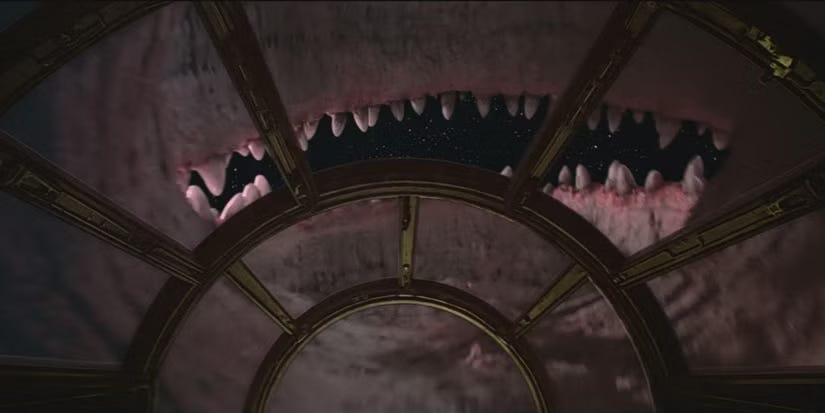
Amitav Ghosh also discusses the way in which we deny the earth sentience. Of course, ancient cultures, who were much wiser (not smarter necessarily, but wiser) were attuned to this. He uses the example for Empire Strikes Back when the Millenium Falcon hides on a strange asteroid. It isn’t until a while passes that the characters (Han Solo etc.) realize they are in the belly of a monster (for the leader image I used a picture viewed from inside the exogorth, rather than the extremely phallic exterior).
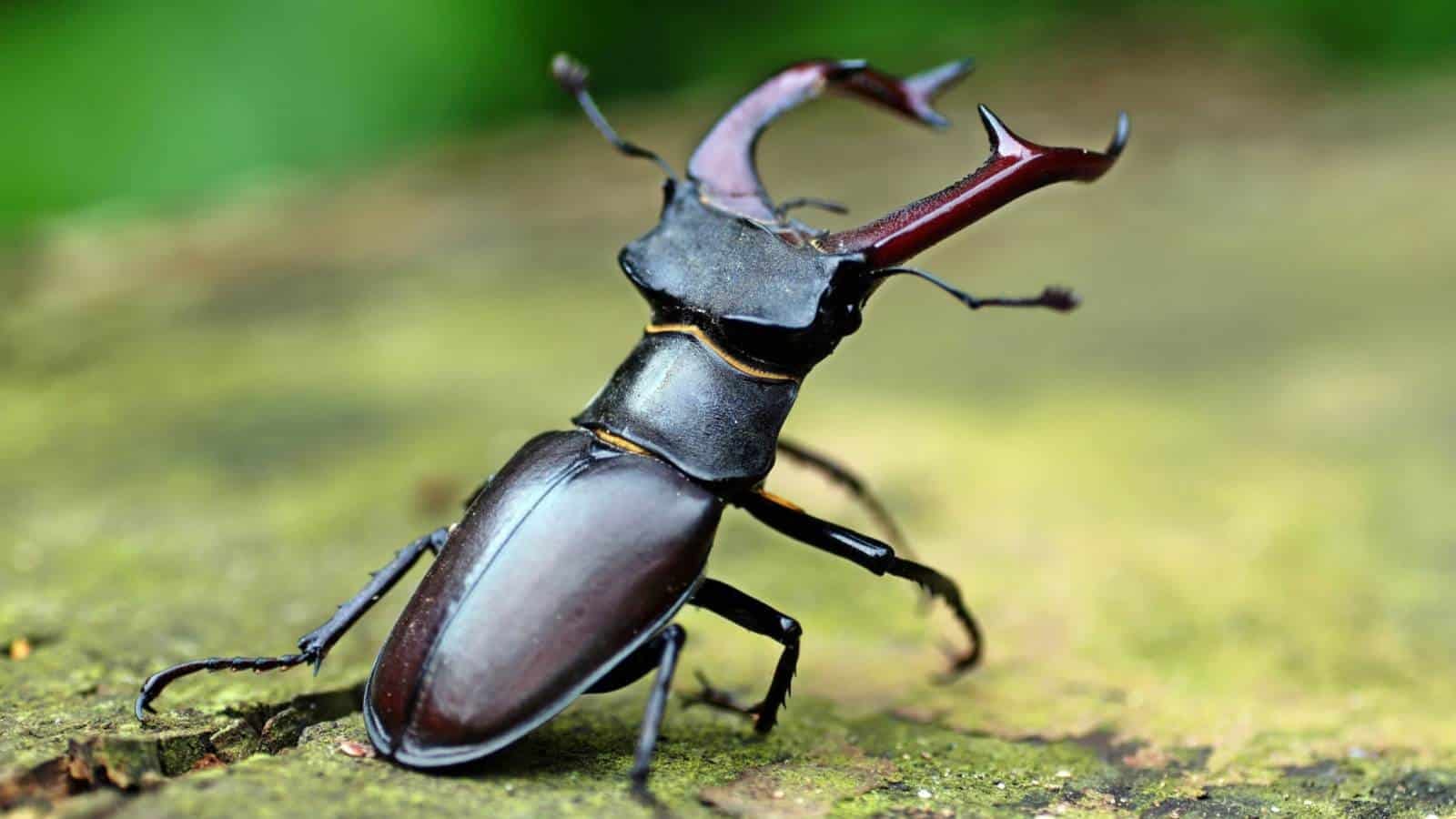
Ghosh uses this analogy to discuss our own earth. The times (even in imagination or dreams) we reach for a vine only to realize it’s a snake. This happened recently to me when I was digging through a wood pile and suddenly had a stag horn beetle (pictured below) snapped all six legs on my finger.
Imagine my surprise!
We forget or choose not to see the earth as a living system. It is an effect of the Uncanny, Ghosh discusses. He also shares an incident in Mumbai from the Seventies (I believe). A horrible storm that killed sixty-plus people. As a young man, he ducked into a bus stop crammed with people, only to be shoved outside for lack of space. He ran several blocks only to come face to face with a tornado touching down on the street in front of him. Terrifying! He took shelter elsewhere, and only learned later that everyone crammed in that bus stop died.
It is hard not to bestow spiritual significance on this if you are Ghosh. However, we as readers, would never believe this event in a novel, Ghosh says. It seems “too unreal,” too coincidental, too unexpected. But yet, it was a defining story of his life.
Ironically, a story most novelists don’t know or don’t realize they don’t know how to tell.
It seems much of modern fiction can only tell us more ideological fictions that are already broadcast through our television sets. It has forgotten how to tap into the natural ancient stories of humanity’s youth. Jettisoned them for something more “modern.”
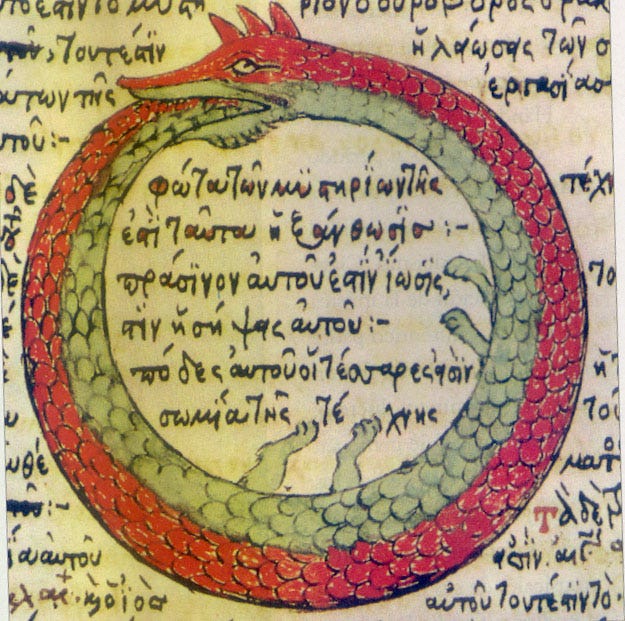
It Ouroboros. Society trying to fix a technological problem with a technological fix, ignoring the fact that everything we need already exists. Much of the way to fix things is to return to the natural solutions, and also show restraint.
I’m not a Luddite. I am extremely grateful for modern medicine, and technology’s convenience. The problem is people forget that those conveniences aren’t the world. It’s a human-made machine that caters to human desire. It tells a different story.
And as we know, if we forget that original story, we forget ourselves.
P.S. I love this earth. I really do. It has taken me almost my whole life to remember what I already knew as a child.
I really enjoyed the third part of this article. It is a fascinating and important topic. Can you recommend specific writings of Amitav Ghosh that get to the heart of this matter? Great post! Cheers!
My field is in natural resource management and my favorite climate solution that has been utilized over the last couple of decades is restorative ocean farming.
The issue with climate change, and this is basically a direct quote from my latest manuscript, is that in order for the “help” to exist, in this case climate solutions, it has to make money in order for it to justify its existence. That’s the main reason why we don’t have any real effort pushing against the climate crisis, because not only does it not make money but in order to actually fix things the people running the show now would have to lose their money. It’s why I’m out of a job.
But anyway, restorative ocean farming is the only solution I encountered that 1. Feeds people 2. Generates income 3. Restores habitat and 4. Fights climate change by storing carbon in geologic time.
If I haven’t recommended it to you already, I urge you to read Eat like a fish by Bren Smith. It might even be a good assigned reading for your class as well.
Anyway, great post and thank you for the updates.